
When people hear the words “truck accident,” they picture one big crash. In reality, how a truck accident happens is just as important as why it happens. And with these facts, your legal team can use that to determine who’s legally responsible.
On Portland roads like I-5 and I-84, different types of truck accidents show up again and again. Each one points to a specific breakdown: driver error, poor training, bad maintenance, or trucking companies cutting corners.
At Dozier Law Group, we work with those who have been injured in these vehicle accident cases, and we know how these crash patterns shape real injury claims.
Commercial truck crashes do not follow the same rules as car accidents. A fully loaded semi can weigh 20–30 times more than a passenger vehicle. Many times, these vehicles take far longer to stop and react very differently in emergencies.
Some of the most common commercial vehicle collision types we see in Oregon include:
Each type tells a story. And that story usually points to more than just a bad moment behind the wheel.
Provide a high-level overview of why commercial truck accidents differ from standard car crashes. Introduce the most frequent types of collisions seen on Oregon highways like I-5 and I-84.
Dozier Law Group has years of expertise in Portland and throughout Oregon, navigating truck Accident laws. Trust our team for effective representation, as we leverage our deep understanding of local regulations and a track record of success to guide you through the complexities of trucking accident litigation
A jackknife accident occurs when a truck’s trailer swings outward from the cab. This forms a sharp 90-degree angle across the roadway. When this happens, the driver loses control almost instantly, and the trailer can block multiple lanes of traffic in seconds.
Jackknife crashes are most triggered by improper braking, especially when the trailer brakes lock up before the cab. Speed also plays a major role. This happens when a truck is moving too fast for conditions; even a routine stop can cause the trailer to swing. In the Pacific Northwest, wet pavement, rain, and slick road surfaces make jackknife accidents more likely, especially on highways like I-5 and I-84.
Once a trailer starts to fold, there’s little a driver can do to correct it. These crashes point to deeper issues, such as inadequate driver training, unrealistic delivery schedules, or a failure to adjust driving behavior for Oregon’s weather conditions.
Truck rollovers happen when a vehicle tips onto its side or flips completely, since large trucks have a high center of gravity, which makes them more prone to tipping than passenger cars.
A big factor in rollovers is improperly loaded cargo. When weight isn’t distributed evenly or isn’t secured correctly, a sudden turn or lane change can shift the load. This causes the truck to lean dangerously and lose balance. Even a trained driver can struggle to control a rig in these situations.
Sudden steering maneuvers can trigger a rollover if the truck is already unstable. Combine that with slippery roads or high winds, and a rollover can happen in the blink of an eye.
These crashes often point to more than just driver error. Investigators will examine cargo loading procedures, shipping schedules, and company policies to determine if the trucking company shares liability.
Discuss the physics of truck rollovers and how high centers of gravity contribute to these events. Highlight the role of improperly loaded cargo and sudden steering maneuvers in causing these catastrophic incidents.
Semi-trucks have large areas around them where drivers can’t see other vehicles. These are called “No-Zones.” They exist on both sides of the truck, directly behind the trailer, and just in front of the cab. Even a small car in one of these spots can disappear from the driver’s point of view.
When other drivers linger in these blind spots during lane changes, merges, or turns, collisions occur. Side-swipe crashes and “squeeze play” collisions are common.
These accidents are not always the fault of the truck driver. In many cases, poor signaling, aggressive lane changes, or tailgating by other drivers contribute, but the truck’s size and blind zones make injuries more severe than the average truck crash. In fact, these are some of the most fatal accidents on the road.
One of the most frightening types of truck crashes is the rear-end collision.
Unfortunately, semi-trucks take much longer than passenger vehicles to come to a complete stop. Even if a car brakes suddenly, a fully loaded rig may need hundreds of feet to come to a halt. That massive stopping distance can turn a minor fender-bender into a serious or fatal collision.
The danger escalates in underride accidents. This happens when a smaller vehicle slides underneath the back or side of a trailer. These crashes bypass the car’s safety features and lead to catastrophic injuries. Underride accidents are common at intersections or in heavy traffic when a truck brakes abruptly or the driver fails to maintain safe following distances.
Federal law now requires underride guards on most trailers, but not all trucks are properly equipped. Unfortunately, not all guards are maintained properly. In these cases, investigating the truck’s compliance with federal safety standards can be vital for proving liability and maximizing compensation for injured victims.
Describe the significant blind spots surrounding a semi-truck, often called ‘No-Zones.’ Explain how failure to check these areas during lane changes or turns leads to side-swipe and squeeze play accidents.
Detail the dangers of a truck’s massive stopping distance and the severity of underride crashes where a smaller vehicle slides beneath the trailer. Mention the federal requirements for underride guards.
Not every truck accident is caused by driver error. Sometimes, mechanical issues like tire blowouts or brake failures can send a massive rig out of control in seconds. A worn tire, improperly inflated wheel, or neglected brake system can quickly turn an otherwise routine drive into a catastrophic crash.
Trucking companies are legally responsible for keeping their vehicles in safe operating condition. That means:
When a company cuts corners or ignores warning signs, victims may have grounds to hold the company liable for failing to uphold its duty of care.
Investigating mechanical failures involves looking at the maintenance records, inspection logs, and black box data. This information can pinpoint exactly what went wrong.
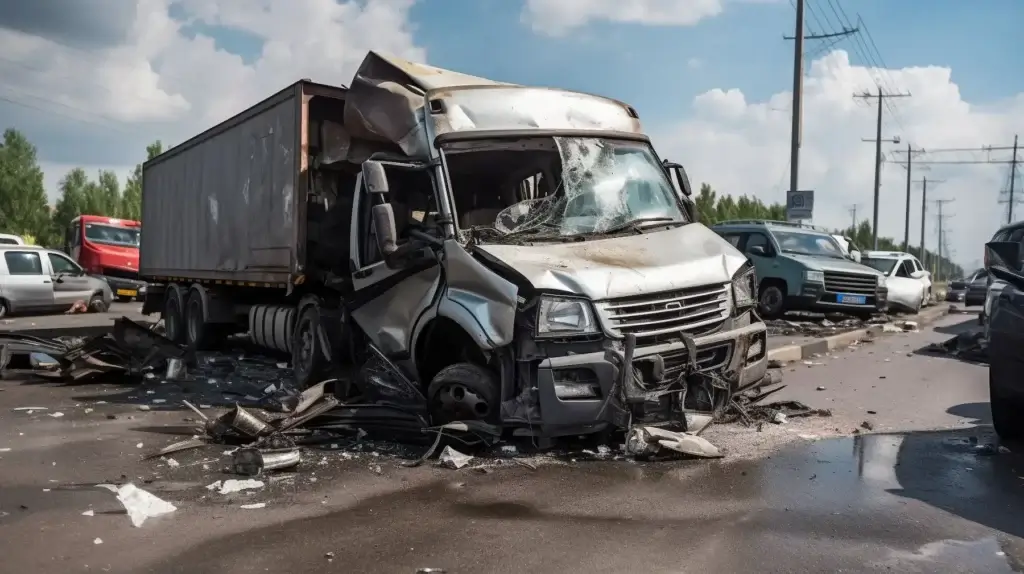
Rear-end collisions and blind-spot accidents are among the most frequent types of commercial truck crashes. Because semi-trucks require much longer distances to stop than passenger cars, they often strike slower traffic from behind, especially in congested areas or construction zones.
Liability in a truck accident can fall on several parties, including the truck driver, the trucking company, the cargo loaders, or the vehicle manufacturers. An attorney must investigate the truck’s ‘black box’ and maintenance records to determine if driver error or mechanical failure caused the crash.
Underride accidents occur when a smaller passenger vehicle slides underneath the back or side of a large trailer, often resulting in the shearing off of the smaller car’s roof. These accidents are frequently fatal because the safety features of the car, such as airbags and crumple zones, are bypassed by the height of the trailer.
Between federal FMCSA regulations, multiple potentially liable parties, and technical evidence like black box data and driver logs, these cases can quickly become a legal nightmare.
Insurance companies know this fact. And many times, they work to minimize payouts by pointing fingers at the victim or downplaying mechanical or regulatory issues.
At Dozier Law Group, we look at every detail. That means our team will:
We work to figure out exactly what happened. Our team will also track down maintenance and inspection records to see if a trucking company neglected its responsibilities.
With a Portland truck accident lawyer on your side, no piece of evidence is overlooked. We handle the heavy lifting with insurers and corporate legal teams, so you can focus on your family and future.
Schedule a consultation with our team today.