
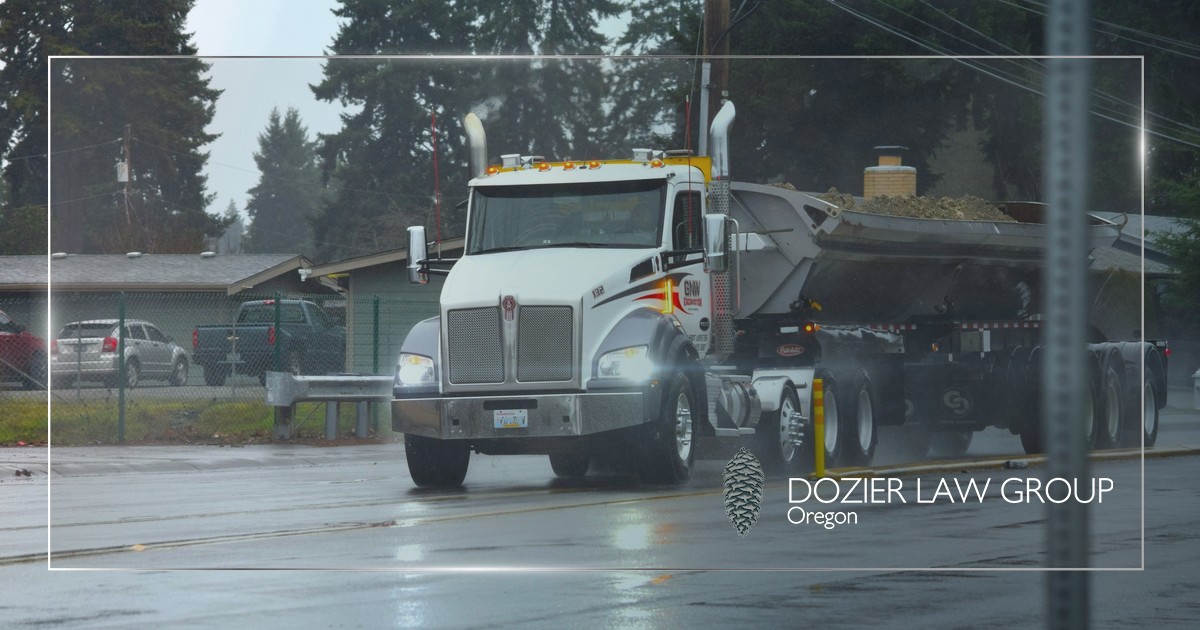
Oregon comparative negligence law can reduce a truck accident recovery by a little, by a lot, or all the way to zero.
That’s why fault percentages matter so much in these cases. In a serious semi-truck crash, a shift of only a few percentage points can change the value of a claim by tens or even hundreds of thousands of dollars.
Oregon uses a modified comparative negligence system. That means an injured person can still recover compensation if their share of fault stays at or below the legal cutoff.
Once that percentage crosses the line, the result changes fast.
The Basics of Modified Comparative Negligence in Oregon
Oregon’s modified comparative negligence allows you (the injured person) to recover compensation as long as your share of fault isn’t greater than the combined fault of the other parties, including the ones you’re suing and any you’ve already settled with. In practical terms, the 51 percent rule Oregon follows means 50% fault may still allow recovery, while 51% generally bars it.
That’s the key difference when people compare contributory negligence vs. comparative negligence.
A strict contributory negligence system can wipe out a claim even when the injured person was only slightly at fault. Oregon takes a less severe approach, but it still has a hard cutoff.
How Partial Fault Reduces Your Truck Accident Compensation
Partial fault in a semi-truck crash reduces compensation in proportion to the amount of responsibility assigned to the injured person. The court or jury first determines the total damages, then that amount is reduced based on the injured person’s fault.
Say a crash causes $800,000 in medical expenses, lost income, and other recoverable losses.
- At 10% fault, the recovery could fall to $720,000.
- At 25%, it could drop to $600,000.
- At 40%, it could be reduced to $480,000.
- At 50%, only $400,000 may remain.
- At 51%, the claim may be barred entirely.
That sharp cutoff is why apportioning fault in Oregon cases can become as important as proving damages.
The difference between 50% and 51% is tiny mathematically. Legally, it can be enormous.
Common Ways Trucking Companies Shift Blame to You
Trucking company defense tactics often focus on increasing the injured driver’s share of fault because every extra percentage point can reduce the amount the company has to pay. The defense doesn’t necessarily need to prove the other driver caused the whole crash.
Sometimes, it only needs to convince an adjuster or jury that the injured person contributed to it.
Common arguments may include:
- Driving too fast for road or weather conditions
- Following too closely
- Making an unsafe lane change
- Using a phone or becoming distracted
- Failing to brake quickly enough
- Failing to react appropriately to traffic conditions
Some of those arguments may be legitimate. Others may be exaggerated.
A passenger-vehicle driver may have made one imperfect decision while the truck driver violated several major safety rules. The real issue is how much each act actually contributed to the crash.
The Impact of Federal Safety Regulations on Fault Analysis
Federal trucking regulations can change the fault analysis by showing whether the commercial driver or trucking company failed to follow required safety standards. Those rules can be especially important when the defense is trying to place a large share of blame on the injured motorist.
Hours-of-service rules are one example.
Commercial drivers generally face limits on how long they can drive before taking required breaks and rest periods. If electronic records show that a driver exceeded those limits, fatigue may become part of the fault analysis.
The same applies to poor maintenance, defective brakes, unsecured cargo, or inspection failures.
A recent semi-truck crash in Oregon shows why those details matter.
In November 2025, a fatal crash east of Bend involved a semi that had jackknifed across U.S. Highway 20. Early in its investigation, Oregon State Police said dark conditions and a lack of active emergency warning equipment were being considered primary contributors. Federal rules require a commercial driver stopped on a highway or its shoulder to turn on the hazard flashers immediately and set out warning devices within 10 minutes.
That kind of evidence can have a major effect on commercial vehicle accident liability.
It can also make it harder for a trucking company to push a large percentage of fault onto the other driver.
Evidence Needed to Counter Comparative Negligence Defense
Countering a comparative negligence defense means that you need evidence that shows what actually happened, not just competing stories about the crash. The goal is to keep your percentage as low as the evidence supports.
Useful evidence may include:
- Electronic logging device records.
- Truck event data and engine control information.
- Dashcam, traffic-camera, or surveillance footage.
- Maintenance and inspection records.
- Cellphone and dispatch records.
- Crash-scene photographs and witness statements.
Accident reconstruction can matter as well.
If your dispute involves braking distance, visibility, speed, lane position, or reaction time, a technical analysis can often help explain why one driver’s conduct played a much larger role than the other’s.
That can be especially important when the defense is trying to push fault closer to the 51% line.
Why Insurance Adjusters Use Fault Percentages to Lower Settlements
Insurers use fault percentages because every point assigned to you can reduce your claim’s value. In an Oregon truck accident case, fault can become both a legal issue and a negotiating tool.
Imagine the insurer agrees that the damages are worth $1 million.
If it argues you were 30% at fault, your claim effectively drops to $700,000.
If it pushes that number to 45%, your potential recovery falls to $550,000.
That’s why you shouldn’t automatically accept an adjuster’s initial fault assessment as accurate. Insurance companies use fault percentages aggressively because they know diminished recovery in personal injury cases can tilt settlement negotiations in their favor.
The number still has to be supported by evidence.
Dozier Law Group Advocates for Truck Accident Victims
At Dozier Law Group, we understand that comparative negligence isn’t a side issue in a truck accident case. When medical bills, lost income, and long-term injuries are significant, the way fault is divided can be the difference between a meaningful recovery and nothing at all.
Contact us today for a free consultation, and let’s make sure you’re pointed in the right direction.